

David Beamonte
19 December 2025
A better way to provision NVIDIA BlueField DPUs at scale with MAAS
MAAS 3.7 has been officially released and it includes a bunch of cool new features. One of the capabilities that stands out most, without a doubt, is the support for NVIDIA Bluefield DPU provisioning directly through the Baseboard Management Controller (BMC).
But, what are BlueField DPUs? This leads to a broader question: what are DPUs and SmartNICs, and why is the ability to provision them through the BMC a significant advancement?
Let’s deep dive into all this.
DPUs and SmartNICs
Today’s data centers face increasing demands: higher throughput, more tenants, rising security threats and the growing complexity of cloud-native environments. Traditional servers struggle when networking, storage, and security functions consume more and more CPU cycles intended for applications.
This trend has driven the industry toward infrastructure hardware acceleration, where specialised processors handle tasks traditionally executed by the host CPU.
A SmartNIC was the logical solution, a Network Interface Card (NIC) enhanced with onboard compute and acceleration hardware. Unlike traditional NICs, which simply move packets, SmartNICs can process, filter, and accelerate data directly on the card before it ever reaches the host CPU.
A Data Processing Unit (DPU) goes further. It is effectively a small, fully functional server on a PCIe card, with its own CPU cores, memory, operating system, security capabilities, and hardware offload engines. DPUs are designed to take over the entire infrastructure plane (networking, storage, security and management) so that the host CPU can focus entirely on application workloads.
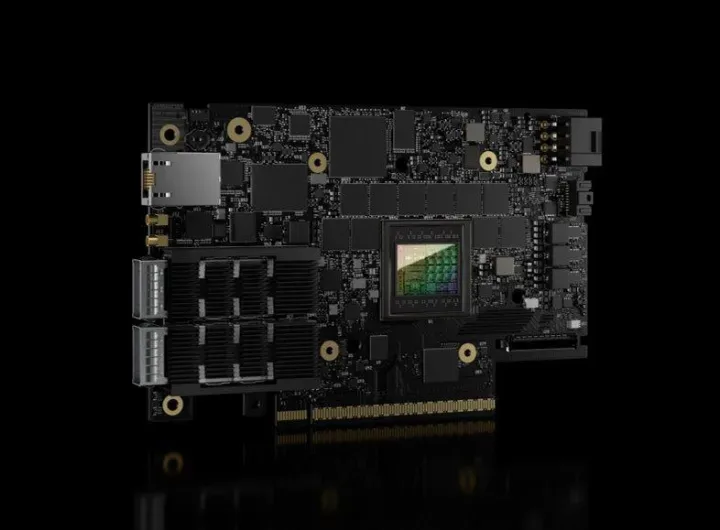
DPUs are increasingly common in cloud, telco, and high-performance environments such as AI training clouds. Typical use cases include:
- Network acceleration/offloading: Implementing Software-Defined Networking (SDN) for OpenStack, LXD/MicroCloud, Kubernetes, and bare-metal, including distributed firewall functionality.
- Storage acceleration/offloading: running agents (like Ceph RBD) to present distributed storage as a standard device.
- Secure root of trust: providing authentication, attestation and isolation, and monitoring the host’s processes and network connections.
- Kubernetes on the DPU: using the DPU as a worker node for packaging and orchestrating network, storage, and security functions.
NVIDIA Bluefield
The NVIDIA BlueField family is NVIDIA’s line of DPUs. This family showcases how NVIDIA has expanded from the original SmartNIC concept into a full platform that supports not only infrastructure offloads but also advanced telemetry, security analytics, and AI-centric workloads, all designed to free up host CPUs and accelerate core operations in modern and distributed data centers.
BlueField-3 is particularly relevant here. It was the first DPU of the family that incorporated a Baseboard Management Controller (BMC), allowing remote monitoring and control of the DPU. A BMC is a dedicated, independent micro-controller embedded on a server’s motherboard (in this case embedded on the DPU) that provides out-of-band management capabilities. It enables administrators to remotely monitor hardware health (like temperature and power), control the server’s power state (turn it on/off or reboot), and access the console.
This independence is what makes clean, automated provisioning possible.
How should you provision a DPU: through the BMC or through the host?
Historically, DPUs were provisioned through the host. The host OS booted first, ran vendor tools, and then configured or imaged the DPU. While workable for early deployments, this approach tightly couples the DPU lifecycle to the host, makes recovery harder, and becomes operationally fragile at scale.
With a built-in BMC, a second option is available: provisioning the DPU directly through the BMC. In this model, the DPU is treated like an independent server. The BMC can power it on, flash firmware, install an operating system, run configuration workflows, and make it operational, independently of the host.
Benefits of BMC-based provisioning include:
- Consistent “day-0” initialization
- Host-agnostic workflows (no dependency on a running OS)
- Easier recovery and re-provisioning
- Cleaner separation between host workloads and infrastructure functions, enabling a zero-trust deployment model
- Better suitability for large-scale or zero-touch environments
This is the provisioning method MAAS now supports.
MAAS now supports BlueField provisioning through the BMC
MAAS (Metal as a Service) is Canonical’s open-source platform for managing physical servers with cloud-like automation. It provides a central place to discover, commission, deploy and repurpose machines. It offers repeatable workflows that make large-scale infrastructure easier to operate and an infrastructure-as-code approach to programmatically automate the whole data center.
With the release of MAAS 3.7, BlueField DPUs can now be provisioned directly through their BMC. This allows MAAS to treat the DPU as an independent server, without relying on the host operating system to initialise or configure it. Behind the scenes, MAAS handles power control, device relationships, and the order of operations required to bring both the host and the DPU online correctly.
Prior to this release, MAAS supported BlueField provisioning only through-the-host, meaning that MAAS needed the host to be provisioned and operational first, before even being able to provision the DPU. While functional, this approach made DPU lifecycle management dependent on the host and limited automation in larger environments.
This new workflow gives operators a cleaner and more predictable way to manage DPUs. By integrating BlueField provisioning into standard MAAS processes, it becomes simpler to adopt DPUs across the data centre and maintain them consistently alongside the rest of the hardware fleet.
Get started with MAAS 3.7
You can start experimenting with BlueField provisioning today by installing or upgrading to MAAS 3.7. The easiest way to get started with MAAS is to follow the comprehensive 30-min tutorial.
For DPU provisioning details and supported workflows, check out the MAAS documentation and the dedicated BlueField provisioning guide.
Give it a try and let us know how it works in your environment.
And if you are interested in getting Canonical’s support and compliance for MAAS, you can explore Ubuntu Pro, or get in touch with our team.


